 WAVES
A short guide to the paper
A blink carries more information than a count. Its timing and completeness can reveal changes in drowsiness, mental workload, and eye health. Can everyday glasses capture that detail?
BlinkWise combines a small millimeter-wave radar with a microcontroller attached to the glasses. The design has two challenges: recovering a detailed eye-openness signal from radar reflections, and processing it within the memory and power limits of wearable hardware.
Start with what a blink reveals and the health studies, then explore how radar sensing and on-device inference work, and how well the system performs.
Paper abstract
Eye blink dynamics offer crucial insights into physiological and cognitive states. Existing solutions either require specialized equipment for detailed measurements or sacrifice temporal resolution for accessibility. We present BlinkWise, the first system that transforms everyday eyewear into a wise device for detailed blink dynamics tracking as a tiny add-on. BlinkWise measures eye openness in real-time on resource-constrained edge devices by leveraging both RF modality’s inherent efficiency and novel computational optimizations—including recurrentization of convolutional network operations, quantization-aware normalization, and a lightweight proposal algorithm. Evaluation with 20 subjects and more than 18,000 blink measurements demonstrated BlinkWise’s high accuracy in capturing subtle blink dynamics at millisecond resolution, achieving a Pearson correlation of 0.981 with ground truth. Through three real-world application studies, we demonstrate BlinkWise’s potential for monitoring cognitive states and ocular health. Code, datasets, and demo videos are available on our website.
Why measure the shape of a blink?
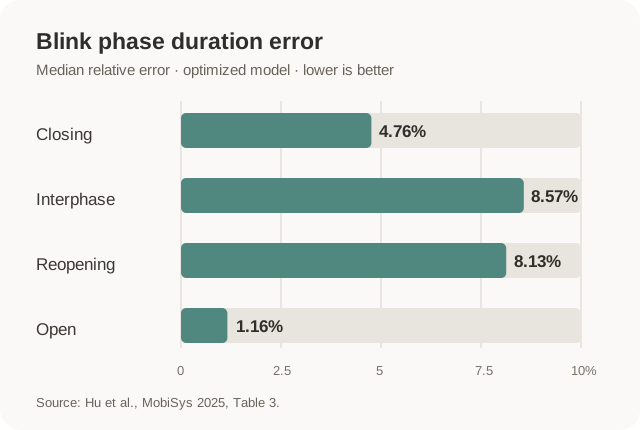
A blink has a closing phase, a near-closed interphase, and a reopening phase, followed by an open interval. Their durations can change with a person's physiological and cognitive state. A blink counter misses these changes, along with the difference between a full and a partial blink.
BlinkWise therefore measures eye openness—a continuous value from closed to open. The shape of this curve preserves both blink timing and completeness. Within eye-tracking research, this is a measure of eyelid motion; it does not estimate gaze direction.
High-speed cameras can capture this detail, but recording and processing images is costly for a small wearable. Electrooculography (EOG) offers another approach, using electrodes in contact with the skin. BlinkWise instead asks whether radar can bring detailed blink sensing to everyday glasses, creating a platform for smart-glasses and mobile-health research.
Blink dynamics for wearable health research
The timing and completeness of blinks connect the eye-openness signal to three questions in wearable health:

Drowsiness Monitoring
Longer blink phases tracked drowsiness measures in eight participants, sampled for five minutes each hour over 12 hours.

Mental Workload
Blink timing changed with task engagement during a ten-participant visual-search study.

Partial Blinks and Eye Health
Continuous openness distinguished partial blinks (AUC 0.86), a possible dry-eye risk marker.
These case studies show associations and sensing feasibility; larger studies are still needed for mental-state prediction or clinical assessment. To study these questions on everyday glasses, BlinkWise must first recover the eye-openness curve from a small radar sensor.
From radar reflections to eye openness
A 60 GHz millimeter-wave (mmWave) radar on the glasses observes the eye region. The cornea and eyelid reflect radio waves differently, so covering and revealing the cornea changes the signal. BlinkWise first filters static reflections and interference from nearby facial motion.
To translate the filtered signal into eye openness, BlinkWise uses a compact convolutional neural network (CNN). A convolution combines nearby samples to detect local patterns; stacking these operations lets the model capture how a blink unfolds over time. The model's U-Net-style encoder and decoder combine information at different time scales to reconstruct the openness curve.
During training, a vision model supplies eye-openness labels from synchronized camera images. The deployed glasses then predict openness from radar alone. This gives BlinkWise a detailed signal without recording eye images during use—but the learned model still has to fit on the glasses.

Running the CNN on a microcontroller
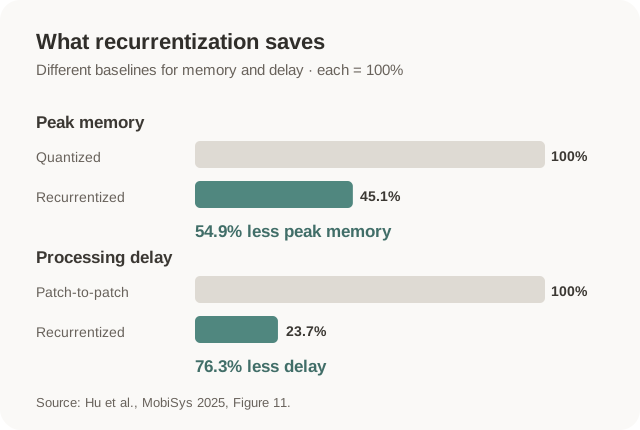
A straightforward implementation of the CNN needs more memory than the glasses' microcontroller can provide. Processing small windows saves memory, but repeatedly computing their overlapping features adds latency.
BlinkWise addresses both with CNN recurrentization: its early layers process the signal in small steps and reuse intermediate features instead of recomputing them. The trained network's operations are preserved. The example below shows how this reuse works.
Recompute or reuse?
A kernel's size is the number of values it reads to produce one value in the next layer. Here, both convolutions slide one position at a time (stride 1), with no padding. Choose an output, then switch strategies.
Completing the on-device pipeline
Recurrentization addresses intermediate memory and repeated computation. BlinkWise also uses 8-bit quantization to reduce the model's footprint. Its quantization-aware normalization adjusts the scale of radar inputs across users and wearing conditions while preserving small blink-related changes.
Finally, blinks occupy only part of the incoming stream. A lightweight event proposal stage identifies likely blink intervals and activates the openness-prediction network for those intervals. Together, these choices make the sensing and inference pipeline practical on a microcontroller.
Blink-tracking accuracy and on-device efficiency
The evaluation tests how well the optimized system preserves blink dynamics. The main dataset contains 18,437 blinks from 20 participants, with the last 10% of each session held out for evaluation. On that split, the system achieved a median eye-openness correlation of 0.981 with the camera reference, with 94.4% precision and 97.7% recall for blink detection (paper §6.2, Table 2).
The prototype consumed about 261 mW. The figures below show the detail retained in individual blink phases and the memory and processing savings that make on-device inference possible.
Limitations and open research questions
Vigorous movement and abrupt shifts of the glasses can disturb the radar signal, and performance may vary for facial structures underrepresented in the evaluation. The case studies are also too small and short to establish robust mental-state or health monitoring. The paper calls for larger deployments, broader populations, and models that directly test those downstream questions.
BlinkWise's contribution is a way to keep the shape of a blink available in everyday eyewear. The evidence here shows that this detailed signal can be measured efficiently; what it can reliably tell us about health and cognition remains a research question.