Surface Characterization with mmWave Signals

Abstract
This paper presents SurfRadar, a fully automatic mmWave system for in-the-wild surface characterization. SurfRadar operates on a mobile robot and estimates intrinsic surface properties including dielectric constant and roughness. Central to our approach is leveraging high-resolution imaging and analyzing coherent surface reflection images rather than raw radar signals. We develop a physics-based model that connects material parameters to these images. Through forward synthesis and backward optimization, SurfRadar recovers the intrinsic parameters that best explain the observed reflection profile. Our results demonstrate accurate characterization across 11 surface types, the ability to produce scene-level semantic maps, and applicability to other datasets.
Physics-Guided Surface Characterization
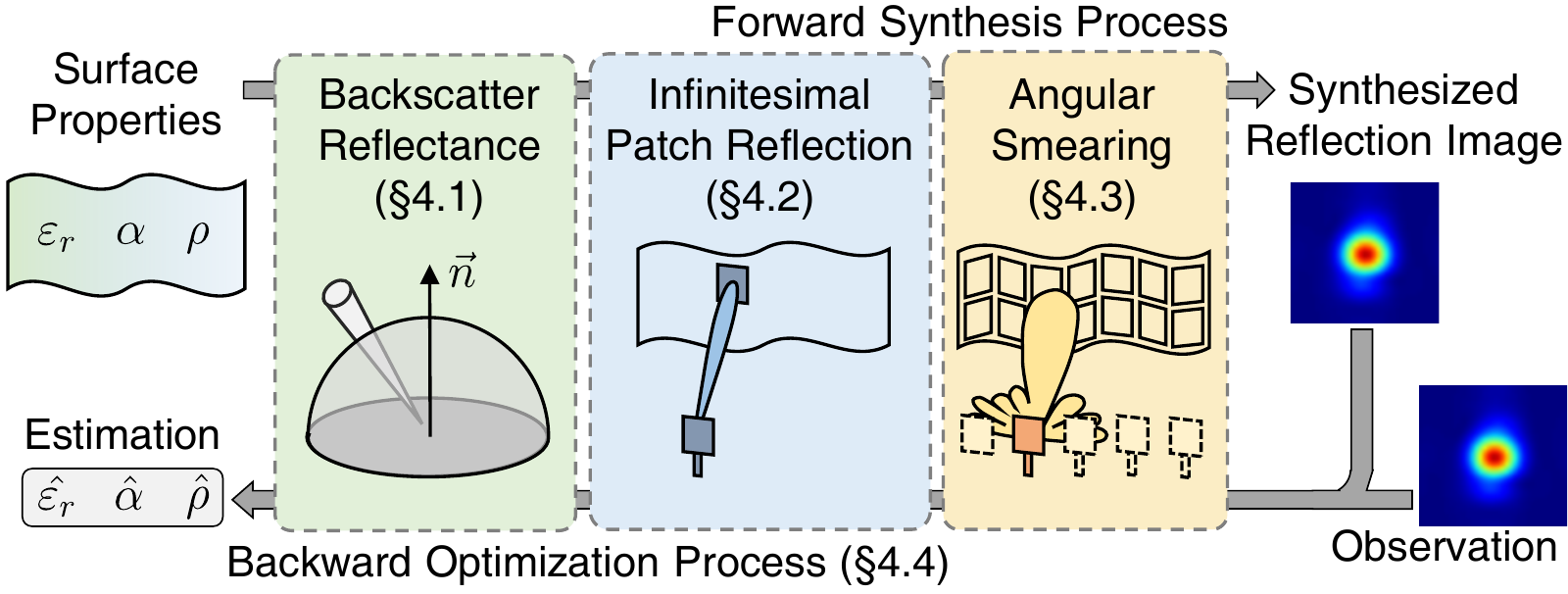
SurfRadar models how surface properties produce the measured reflection image. Its forward process combines a microfacet-based backscatter model, the radar response of infinitesimal surface patches, and array-dependent angular smearing. The backward process then searches for the dielectric constant, roughness, and diffuse albedo whose synthesized image best matches the observation.
- Backscatter reflectance captures how intrinsic properties change angle-dependent RF reflection.
- Patch reflection connects reflectance and surface geometry to the received signal through the radar range equation.
- Angular smearing accounts for finite array resolution and produces a faithful surface reflection image.
In-the-Wild System

High-resolution range and surface-normal estimates enable automatic surface detection, segmentation, and property estimation at each robot position. CartoRadar provides global poses so that predictions from unrestricted robot motion can be fused into a consistent 3D map.

Geometry alone cannot separate different materials on the same plane. SurfRadar resolves this ambiguity by accumulating confidence-weighted material votes across viewpoints, producing stable boundaries while suppressing local prediction noise.
Results

Across 3.6k measurements from 11 surface types in five buildings, the estimated properties form tight, well-separated clusters. Smooth and rough variants of the same material remain aligned in dielectric constant while separating along roughness, showing that the model disentangles the two physical factors.

A simple K-nearest-neighbor classifier operating on the recovered physical properties achieves 97.5% accuracy across all 11 material classes.
3D Material Mapping
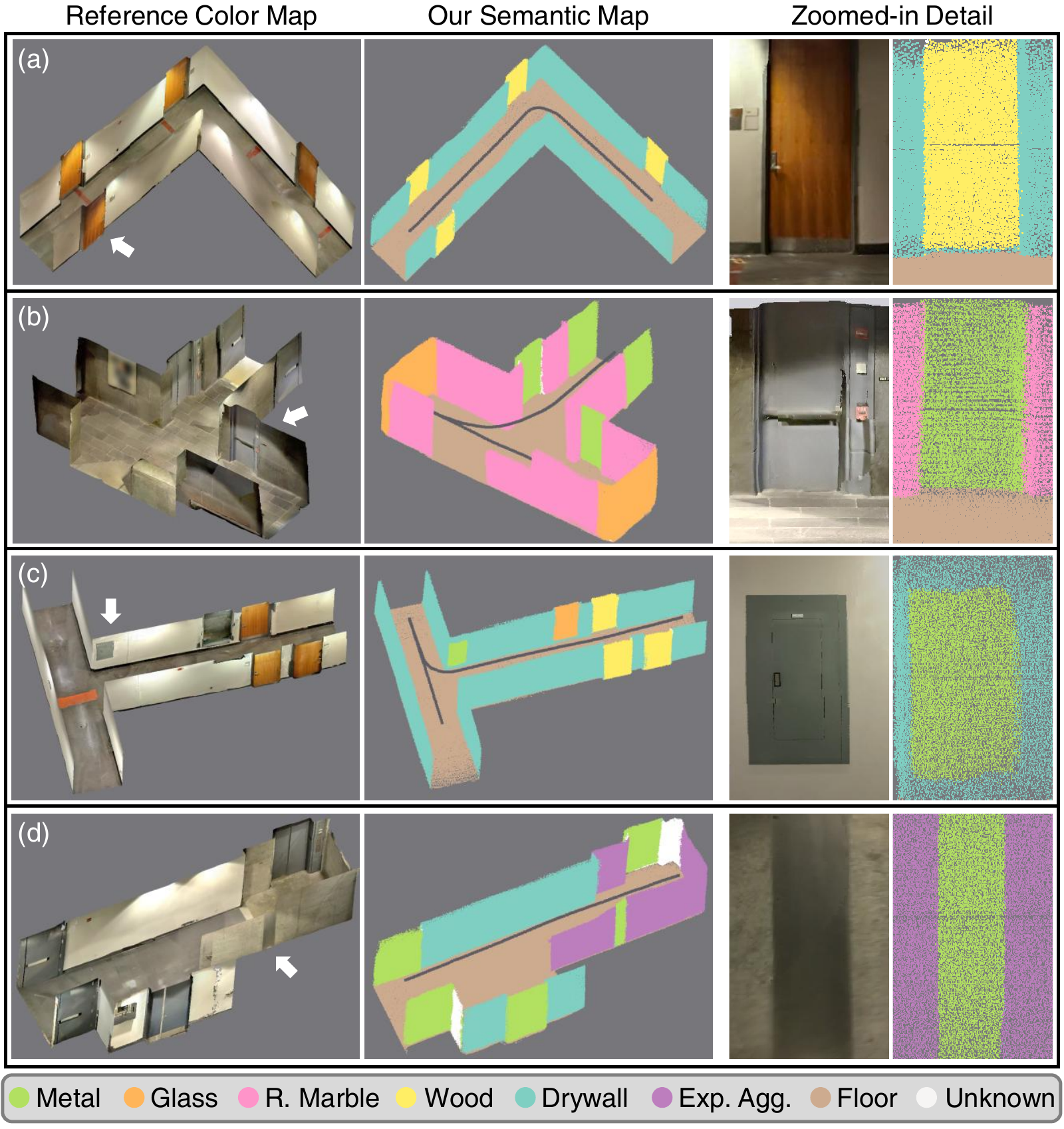
Aggregating observations along the robot trajectory extends RF sensing beyond geometry to semantic scene understanding. The maps distinguish materials such as drywall, wood, glass, metal, marble, and exposed aggregate, including precise boundaries between co-planar surfaces.
Code and Dataset
The dataset contains 3.6k surface reflection images spanning 11 surface types across five buildings, collected at distances of 1-4 m and robot speeds of 0-0.3 m/s under unrestricted orientations.
Code and dataset will be released soon to support future research.
BibTeX
If you find SurfRadar useful for your work, please consider citing:
@inproceedings{surfradar,
  title={Surface Characterization with mmWave Signals},
  author={Lai, Haowen and Lan, Zitong and Hu, Dongyin and Zhao, Mingmin},
  booktitle={Proceedings of the 24th Annual International Conference on Mobile Systems, Applications and Services (MobiSys)},
  year={2026},
  doi={10.1145/3745756.3809230}
}
Acknowledgments
This work was carried out in the WAVES Lab at the University of Pennsylvania. We thank the anonymous reviewers and our shepherd for their constructive feedback, and Zhiwei Zheng for the discussions. This work is supported in part by the National Science Foundation under Grant No. 2516558.
This project page template is adapted from Nerfies.